Jason Rohrer’s new art game: Gravitation

Gravitation by Jason Rohrer

Gravitation is another art game. It’s good. It’s also easier for new players to “get” than Passage, which hopefully will help more people realize how interesting these games are.

Here is the link.

If you’re not familiar with Jason’s previous game, Passage, you can get it here.

If you’re new to this whole Art Game thing, you may want to check out Rod Humble’s The Marriage and the more-difficult Stars over Half Moon Bay.

It’s great that Jason is managing to create such good games in such a short time period. It makes me wonder if I’ve been going the wrong way working 3 years on Braid.

Jonathan Blow interviewed by Jeff Lindsay over at Gamehelper.

This email interview of Jonathan Blow was conducted by Jeff Lindsay a few weeks ago. Please disregard the excessive personality-glorifcation at the beginning.

This was a good interview to do, because I managed to clarify several points in my thinking about game development.  Here’s an excerpt:

Marketing is not, in fact, a need.  Getting enough people to buy your game such that you make money is not a need, if you really care about the integrity of what you are making.  That integrity is the primary need; earning enough money through selling that thing, such that you can make more without taking up another job or whatever, is a luxury. People bend to this luxury all the time.  There are lots of ways to rationalize it.  But I think it is usually due to weakness — or rather, lack of commitment to principles.

Among indies there is some kind of desire to be more like bigger companies, to be “professional” about making games.  Owning a business and making money and having business cards is all part of that.  But if you really care about games, it’s a huge mistake, and being “professional” will only hurt your work and cause it to be mediocre. Business is, inherently, a corruptive influence on everything that is non-business.

If you are fluent in a language, drop me a line.

I’m looking for a handful of volunteer playtesters to help verify that the translations of Braid into various languages are doing a good job.

Braid is in the process of being translated right now. The translators seem like they know what they are doing, so I have no explicit reason to be worried about the quality of the translations. However, it would seem weird to me to just take the translated version of the game and put it out into the world without doing some kind of due diligence on the result (especially given how many badly-translated games we have all seen!)

So if you are fluent in one of the following languages, drop a note here with a way to contact you (it doesn’t have to be public; just let it go into moderation and I will read it). And I will set you up with a playtest copy of the game. I mean seriously fluent, i.e. speaks the language like a native; not, hey, I had a couple of years of that in school.

The languages are: French, German, Spanish, Italian, Portuguese, Japanese, Korean, Traditional Chinese (which I guess means Mandarin non-simplified?)

Thanks!

Nuances of Design next week.

Nuances of Design is a session I am running at the GDC next week, on Friday, February 22nd.

The idea behind this session is to let the audience play games in real time while the presenters guide them through the experience to make certain points and encourage certain observations. Because games are about interactivity and not passive absorption, it always seemed weird to me that we used passive absorption (listening to lectures) in order to communicate about games.

If you’d like to participate, please bring a laptop that can run small games well (i.e. Windows XP or Vista, though I think last year a few people managed to run with Macs and emulation), and also a pair of in-ear headphones. (With headpones like these you can stick half in one ear, to hear the game, and leave the other ear open to listen to the presenter). We will pass around USB flash drives containing the games.

This will be the second time I’ve done this session; the first one, last year, went very well.

I’m also potentially looking for one more presenter/game so if you are interested, and have a game that you don’t mind people getting copies of, which is conducive to being played in a short session, then email me (or post here). Thanks!

Another lecture, this time from Denmark.

I gave this lecture as the keynote at the Nordic Game Jam in Copenhagen. You can download it as a .zip file containing the PowerPoint slides, along with an mp3 of the audio.

(Nordic Game Jam lecture, 35MB).

It’s about how to develop high-quality games as an indie or a student; but unlike the prototyping lecture I gave before, this one revolves around the different categories of development tasks, and the ways in which people get stuck creating games that fall far short of their real potential.

Continue reading Another lecture, this time from Denmark. →

A lecture I just gave at Game Focus Germany.

The title is “Programming is Easy; Production is Harder; Design is Hardest.” I gave this lecture on January 24, 2008 at the Game Focus Germany conference. Casey Muratori and Electronic Arts are the absent guest-stars of this lecture. I’m still not sure exactly what this lecture was about, but people seemed to like it all right.

Here is the link to the lecture, which is a .zip file containing PowerPoint slides and an mp3 audio track. The full zip is about 30 megabytes.

This lecture was not a keynote, so its subject matter is smaller in scale than the past couple of lectures I’ve posted.

I like hanging out in Germany. I would definitely come back next year!

Ad Blitz.

The title is a bit of an overstatement. But recently we were thinking about what the ads for Braid would be like. (It’s actually a requirement of Xbox Live Arcade for a game to have some bitmap ads made, which can be placed on the Live dashboard and on the web site).

I deeply dislike ads, but I took this as an exercise to come up with something simple that communicates useful things about the game in a straightforward way; that is faithful to the nature of the game, without being base in the hope of attracting peoples’ attention; and that is respectful of the viewer’s attention. After some back-and-forth with David we came up with the following:

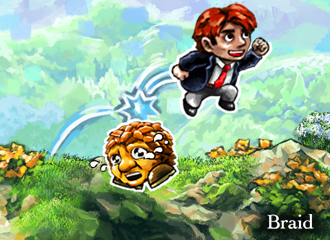
Braid Xbox Live Arcade Banner

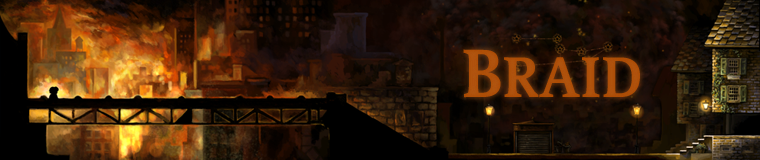
Braid Live Billboard

We did not put a huge amount of effort into these; we feel it’s more important to put the real effort into the game. But I think they’re relatively sophisticated and communicate a lot about the game in a simple fashion. (For example, most people who have played platformers will probably understand the genre just from this picture).

One thing they don’t communicate, unfortunately, is that this is a sophisticated puzzle game about time manipulation. But that seems like the kind of thing that is difficult to communicate in a bitmapped ad like this, without resorting to lots of verbiage and betraying the aesthetic of the game, or else just being ineffective.

So we’re settling with conveying the art style and the conflicted sense of emotion, and from there people can download the free demo and see if they like the time stuff.

New Year’s Resolutions for Game Industry Newbies.

Gamasutra and Game Career Guide recently published an article coaching enthusiasts on what they can do in 2008 to break into the game industry.

Chris Hecker pointed it out to me, because it was such a bad list, and would actually be detrimental to anyone following its advice.  We chatted for a bit about what the real list ought to be; then he wrote it up, and you can read it here.  [You can find a link to the original article at the beginning of that one; it’s bad enough that I cannot conscionably link it here.]

Continue reading New Year’s Resolutions for Game Industry Newbies. →